
A composite deck costs more to build than a wood one in the Boston area, but the gap is smaller than many people expect. In the 2025 Cost vs. Value report, the same 16x20-foot deck averaged $25,806 with composite decking and $20,594 with pressure-treated wood, a difference of about $5,200. Here is what that money buys, and how to decide which one fits your home.
Key points
- In the 2025 Cost vs. Value report, a 16x20-foot composite deck averaged $25,806 in Boston; the same deck in pressure-treated wood averaged $20,594.
- Both decks in that report sit on pressure-treated framing. The difference is the decking and railing on top.
- In Boston, the composite deck recouped 72.5% of its cost at resale, against 66.4% for wood.
- Composite is chosen for low maintenance; wood costs less up front and needs regular sealing or staining.
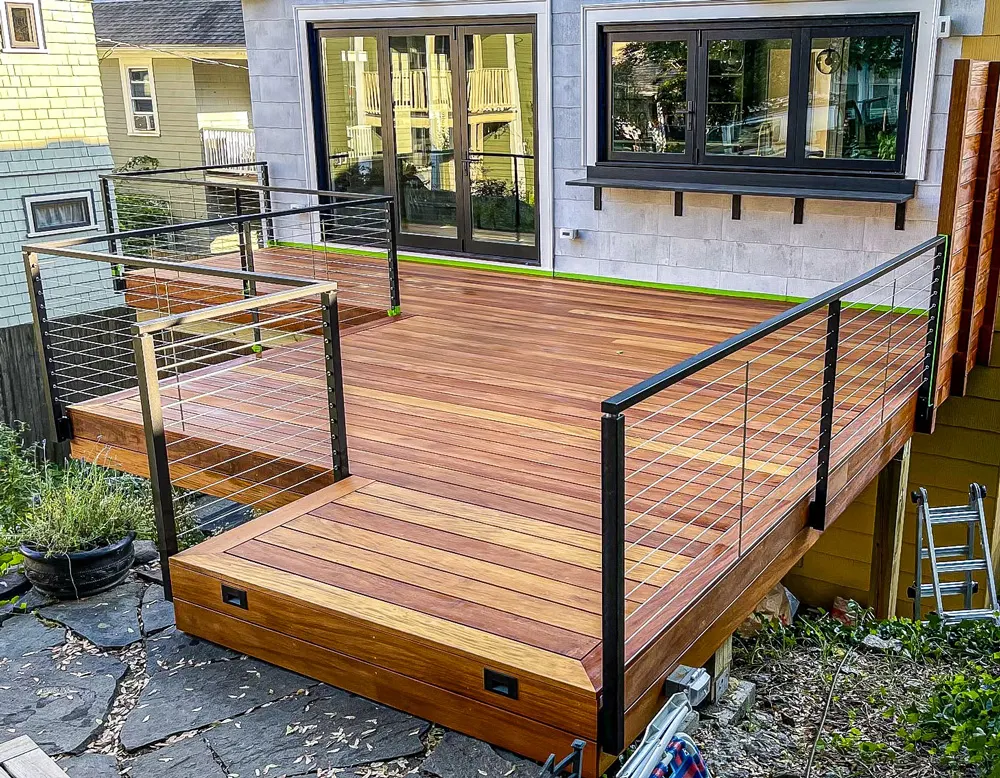
What a deck costs in Boston: the 2025 numbers
Cost vs. Value, published by the Journal of Light Construction, prices the same remodeling projects in 119 U.S. markets every year and compares the cost with the value the project adds at resale. Its 2025 edition is the most recent one, and it has a Boston report with New England and national figures next to it.
Both deck projects are a 16x20-foot deck on pressure-treated joists and posts anchored to concrete piers, with a built-in bench and planter and three steps down to grade. The wood version uses pressure-treated deck boards and a wood railing; the composite version uses composite decking with a matching composite railing.
| Project | Boston | New England | National |
|---|---|---|---|
| Wood deck, job cost | $20,594 | $20,603 | $18,263 |
| Wood deck, cost recouped | 66.4% | 79.1% | 94.9% |
| Composite deck, job cost | $25,806 | $25,817 | $25,096 |
| Composite deck, cost recouped | 72.5% | 95.8% | 88.5% |
Why composite costs more, and what you get back
The framing under both decks is the same pressure-treated lumber, so the extra cost of composite is in the boards and railing you see and walk on. Composite boards are made to resist rot and splintering and do not need to be stained, which is why homeowners searching for low maintenance decking usually land on them.
In the Boston numbers, composite also held more of its value at resale: 72.5% of the cost recouped, against 66.4% for wood. Treat that as an average across one market, not a promise for a single house.
When a wood deck still makes sense
Wood costs less up front and has a classic look many older New England homes suit well. The trade-off is upkeep: wood decking needs to be cleaned and sealed or stained on a regular schedule to hold up to Boston winters and summer sun.
- Choose wood if the up-front budget matters most and you do not mind regular staining.
- Choose composite if you want less maintenance and a deck that keeps its look with less work.
- Either way, the framing, footings and stairs are what make a deck last, so they deserve as much attention as the boards.
Questions about this topic
How much does a composite deck cost in the Boston area?
In the 2025 Cost vs. Value report, a 16x20-foot composite deck averaged $25,806 in Boston. Your price depends on size, height, stairs, railing and site conditions, so the best number is a free estimate for your yard.
Is composite decking worth it in New England?
It costs more up front, about $5,200 more than wood for the same deck in Boston in 2025, but it needs far less upkeep and recouped a higher share of its cost at resale in that report.
Does RFS Builders build both wood and composite decks?
Yes. We build classic wood decks and modern composite decks, with materials that stand up to Boston weather.
Deck Building from RFS Builders
From classic wood to modern composite, we build decks with materials that stand up to Boston weather, with options to fit your style and budget.
Sources
- Cost vs. Value 2025, Boston, MA (with New England and national figures), Journal of Light Construction
- Cost vs. Value 2025: Deck Addition, Wood, project description, Journal of Light Construction, June 20, 2025
- Cost vs. Value 2025: Deck Addition, Composite, project description, Journal of Light Construction, June 20, 2025